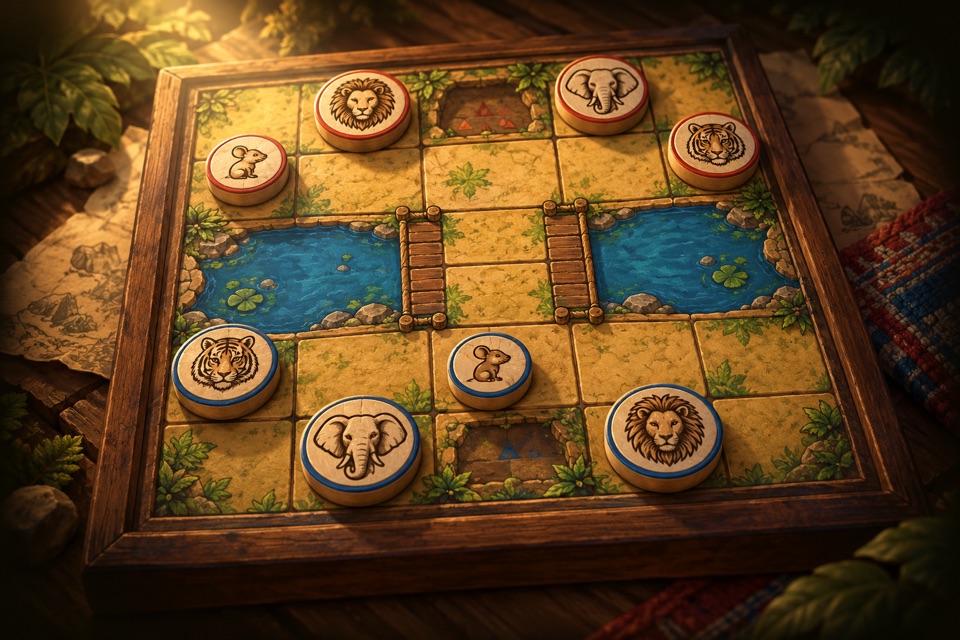
Jungle Chess
Rats beat elephants. Lions leap rivers. First animal into the den wins.
A two-player strategy board game from China: rats beat elephants, lions leap rivers, and the first animal into the enemy den wins.
How to play
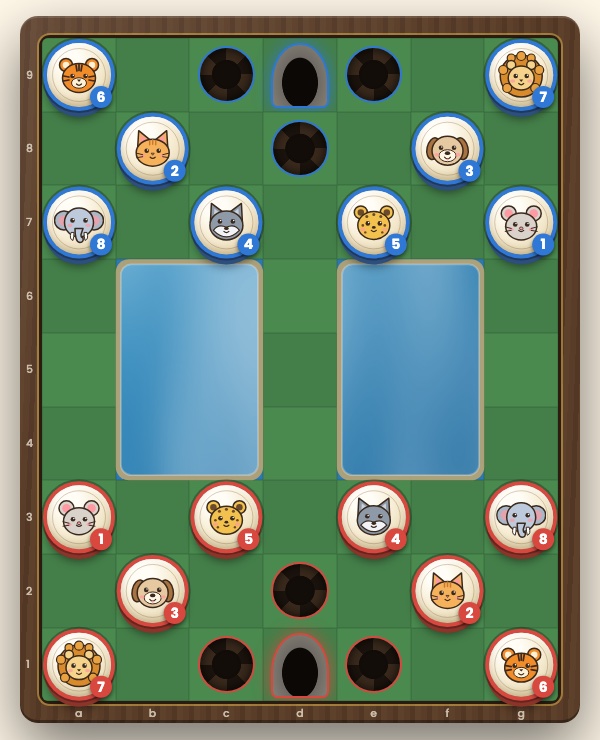
- 1Each side has 8 animals. Strength goes from rat (1) up to elephant (8). A stronger animal captures a weaker or equal one.
- 2Exception: the rat can capture the elephant, but the elephant can never capture the rat.
- 3Move one square up, down, left or right. Only rats may swim in the rivers.
- 4Lions and tigers can jump straight across a river, unless a rat is in the way.
- 5An enemy animal on one of your traps loses all strength and can be captured by anyone.
- 6Win by stepping into the enemy den, capturing every enemy piece, or leaving them with no move.
Full rules (technical)
Jungle (Dou Shou Qi)
Jungle is a two-player game on a 7-column by 9-row board. Coordinates are written
[col, row], with columns 0..6 from left to right and rows 0..8 from bottom to top.
Seat 0 starts at the bottom and moves first; seat 1 starts at the top.
Board
Each player has one den. Seat 0's den is [3,0]; seat 1's den is [3,8].
Each den has three adjacent traps. Seat 0's traps are [2,0], [4,0], and [3,1].
Seat 1's traps are [2,8], [4,8], and [3,7].
The river consists of the 12 squares whose columns are 1, 2, 4, or 5 and whose
rows are 3, 4, or 5. Every other square is land.
Pieces
Each side has one piece of each kind. From weakest to strongest, the ranks are:
rat (1), cat (2), dog (3), wolf (4), leopard (5), tiger (6),
lion (7), and elephant (8).
Movement
An action has the form {from:[c,r], to:[c,r]}. A normal move goes one square
orthogonally. A piece cannot leave the board, enter its own den, or move onto a friendly
piece. Only rats may enter river squares. Rats may move from the river back onto land.
Lions and tigers may jump across the river. A horizontal jump crosses exactly two river
squares, from one bank to the opposite bank (for example [0,r] to [3,r] or [3,r]
to [6,r], where r is 3, 4, or 5). A vertical jump crosses exactly three river squares,
for example [c,2] to [c,6] for c equal to 1, 2, 4, or 5. Every river square crossed
must be empty. Any rat, from either side, blocks a jump. The landing square may be empty
or contain an enemy piece, but may not contain a friendly piece.
Capturing
A piece may capture an enemy piece of equal or lower rank. A rat may capture an elephant; an elephant may not capture a rat. A piece in the opponent's trap has effective rank 0, so any enemy piece may capture it. A piece in its own trap keeps its normal rank.
A rat in the river can capture only an opposing rat that is also in the river, and can be captured only by such a river rat. Land pieces, including a land rat, cannot capture a river rat or be captured by one. A river rat cannot capture a land piece. A land rat can capture a land elephant normally.
Captures remove the captured piece from the board. Moving into an enemy den wins the game for the moving side. Capturing all opposing pieces also wins.
Draws and no moves
If the side whose turn begins has no legal move, that side loses. The game is drawn when 400 plies have been played, or when 100 consecutive plies have passed without a capture. These limits may be configured by the engine. A ply is one move by one side; a capture resets the no-capture counter.
After a win or draw, neither side has an active turn.
Play with your AI
Create a room, copy a seat link, and paste it to your AI assistant with: "Open this link and play with me." Any assistant that can open web pages can sit at the table.
AI agents →How do you win at Jungle Chess?
Move any of your animals into your opponent's den, capture all of their pieces, or leave them with no legal move.
Can a rat really capture an elephant?
Yes. A rat can capture an elephant, but an elephant can never capture a rat. A rat swimming in the river cannot capture anything on land.
How do lions and tigers cross the river?
They jump straight over the water in a single move, as long as no rat is in the way. They can capture the piece they land on if its rank is not higher.
What are traps for?
An enemy piece standing on one of your traps loses all of its rank, so any of your pieces can capture it.
Can I play Jungle Chess against an AI?
Yes. Play the built-in bot instantly in your browser, or invite your own AI assistant to a seat and play together.